Pace as a variance lever: real but modest
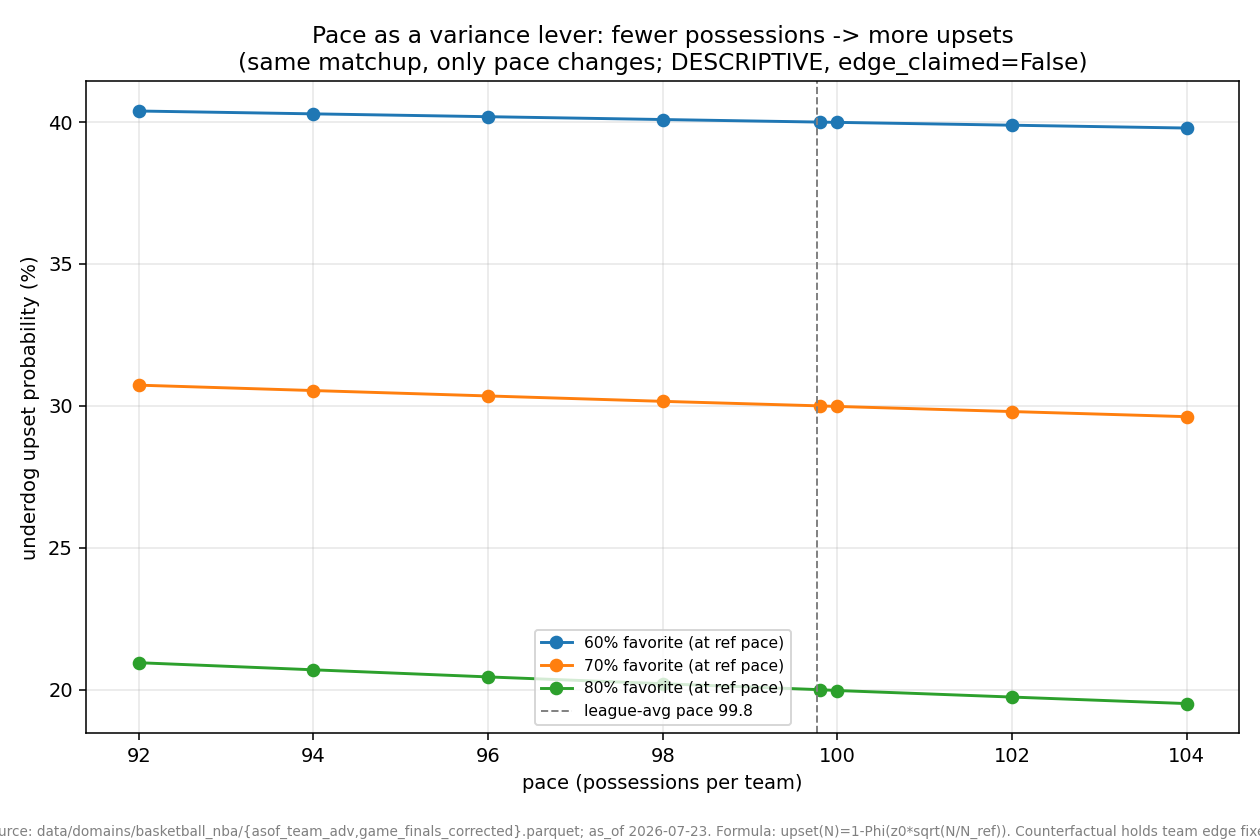
Pace is a real but MODEST variance lever: across the observed NBA pace range (~92-104) the same matchup's upset prob shifts by only a few points -- fewer possessions favor the underdog (sqrt(N) scaling), but the effect is small because r...
How to read this figure
Each curve fixes a favorite's strength at reference pace, then reprices its upset probability at every pace on the grid; the slow-minus-fast swing is the whole span of that effect.
Continue with the data
Open the interactive analysis: Favorite win probability across pace assumptionsWhat it means
Fewer possessions mean fewer chances for the better team to separate, so the underdog's chances grow as pace slows -- the sqrt(N) scaling of a possession-margin model. But because real NBA pace barely moves game to game, the mechanical effect on any single matchup is small: a couple of upset-probability points, not a coin flip. A slow, grind-it-out game genuinely helps the underdog, just not by much.
Caveats and confounds
COUNTERFACTUAL floor: per-possession scoring margin and variance are held pace-invariant, so this isolates the mechanical variance effect only, not behavioral changes (teams that push pace may also change shot quality). Margin is assumed Normal (CLT over ~100 possessions), weaker for short in-game windows.