Point of no return: when a lead becomes permanent
Per game, order score ticks by (game-clock, ts); a margin threshold's point of no return is the first tick from which |home_score-away_score| stays >= threshold to the end. Reads only the score path, not model/market prob.
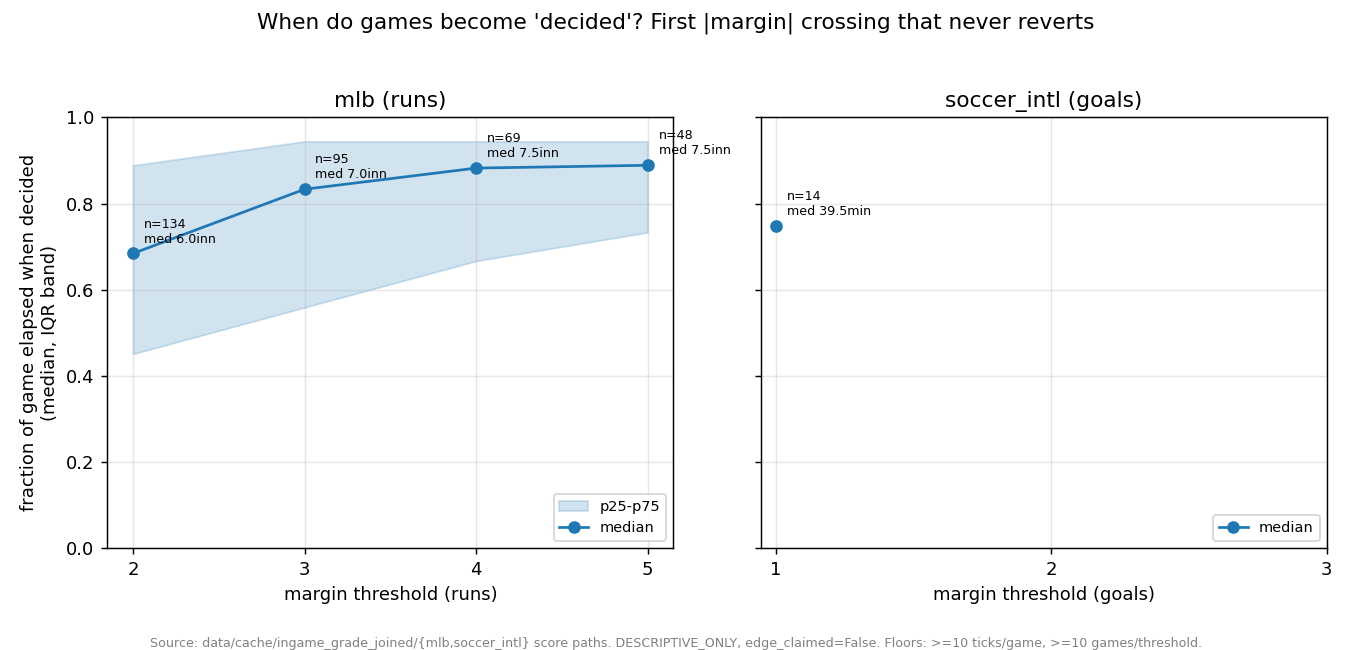
How to read this figure
For each (sport, threshold), decided_frac_of_games is how often that gap ever became permanent and decided_clock_median is the typical clinch time; cells below the game floor are masked.
Published coverage
The committed artifact is partial; only its published coverage is shown here.
| Population | Status | Games | Usable buckets | Published reason |
|---|---|---|---|---|
| MLB | unknown | - | - | - |
| SOCCER_INTL | unknown | - | - | - |
Continue with the data
Open the interactive inspector: Blowout timingWhat it means
For each game the module reads only the score path and finds the point of no return: the first moment a margin threshold holds to the final whistle. The pattern is intuitive but now measured -- small leads (2 runs) become safe around the middle innings in most games, while large leads (5 runs) are, by definition, built later and in far fewer games. This module carries MLB and international soccer only; the NBA cut is not present in this artifact.
Caveats and confounds
Descriptive game-flow measurement. It reads the score path, not any model or market probability, and a (sport, threshold) cell below the 10-game floor is masked from the headline (e.g. soccer above a 1-goal gap). These are revision 2 numbers, measured on the segment-clean corpus; revision 1 read 178 usable MLB games and clinch times one to one and a half innings later because a stored file could hold two games' score paths end to end.